

Last Updated: November 4, 2026
Quick Summary
To practice pickleball alone, run 30- to 40-minute solo sessions split roughly 40/40/20 across serves, groundstrokes, and touch, with a five-minute warm-up first. Hit 20 serves to each corner, do 20 shadow swings per side, and aim for 30 wall dinks in a row.
- Solo practice lets you hit 200 serves in 30 minutes versus about 15 in a real game.
- Move to a harder variation only after hitting your target twice in a row.
- Full swings need 10 feet of clearance, dinking needs 6 feet, and paddle control needs almost nothing.
- Keep home sessions to 15 minutes and focus on quality reps, not exhaustion.
Table of Contents
- Why Solo Practice Works (and What It Can't Fix)
- Pickleball Drills by Yourself: The Core Session Plan
- How to Practice Pickleball Alone at Home
- Build Your Solo Practice Plan Around Your Rating
- Frequently Asked Questions
Why Solo Practice Works (and What It Can't Fix)
Solo practice works because repetition builds the one thing match play rarely gives you: volume. When you practice pickleball alone, you can hit 200 serves in 30 minutes; in a real game, you might hit 15.
Reps first, strategy second, matches third.
Solo work cannot teach you to read an opponent's paddle angle or handle a partner who poaches every ball, those skills need live play.
A common mistake is treating solo sessions as warm-up. They are training. Treat them that way and your consistency climbs.
Pickleball Drills by Yourself: The Core Session Plan
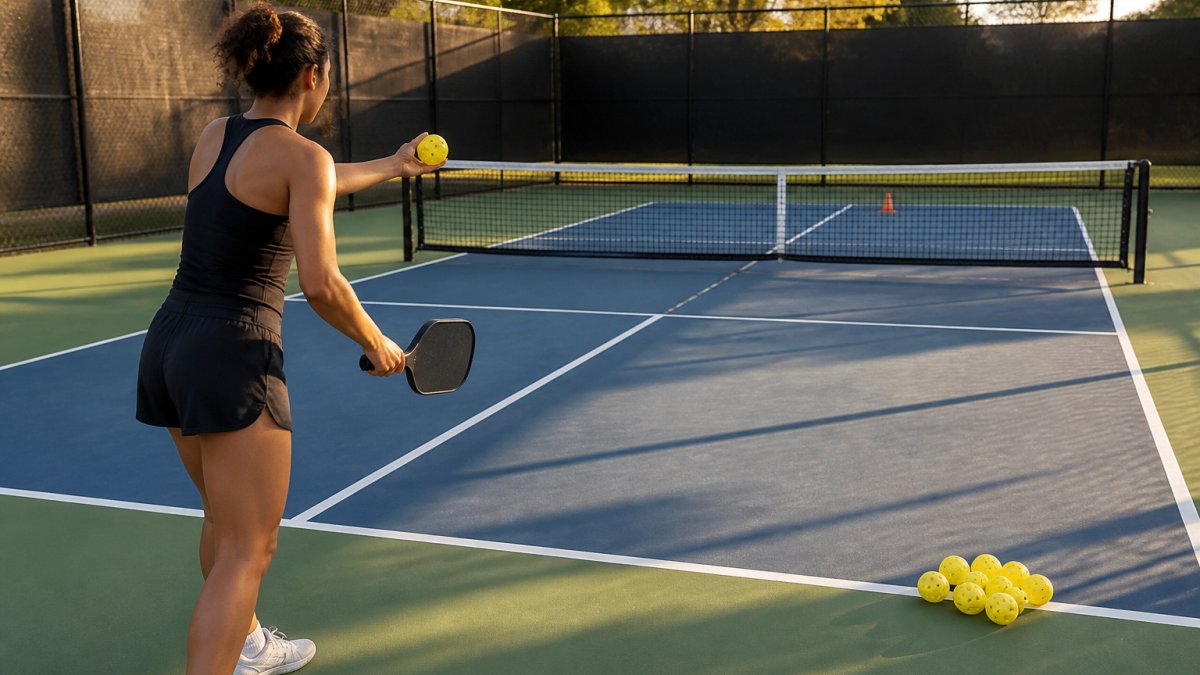
Matching the Drill to Your Space
Use this rule: full swings need 10 feet of clearance, dinking and touch work need 6 feet, and paddle control and footwork need almost nothing. A short daily habit of the right drill beats a long session of the wrong one.
How to Practice Pickleball Alone at Home
Home practice is about the small stuff: touch, footwork, and swing path. You do not need a court.
Try these at home:
- Shadow swings in front of a mirror to check your form
- Wall dinking against a garage or basement wall
- Split-step and lateral movement drills in a hallway
Keep sessions to 15 minutes. The goal is quality reps, not exhaustion. A short daily habit beats one long weekend session.
Build Your Solo Practice Plan Around Your Rating
Your rating should shape your solo plan. A 3.0 player needs fundamentals. A 3.5 player needs consistency under pressure.
Here is how to structure it:
| Rating | Focus | Session Length | Frequency |
|---|---|---|---|
| 3.0 | Serves, ready position, contact point | 20-30 min | 3x per week |
| 3.5 | Dinking, ball control, unforced errors | 30-40 min | 3-4x per week |
| 4.0 | Shot selection, advanced patterns, pressure reps | 40-50 min | 4x per week |
The 3.5 plateau is real, and it is usually a consistency problem, not a talent problem. Players stuck there often practice the same shots they already hit well. Break the plateau by drilling your weakest shot, not your favorite one.
Our Pickleball Rulez skill-level workbooks are built around this exact idea: targeted drills for your rating, not generic advice.
The National Institute on Aging guidance on staying active is a good reminder that smart, steady practice keeps active adults on the court longer.
Solo practice will not replace match play, but it builds the reps that make match play count.
Frequently Asked Questions
Is it possible to practice pickleball by yourself?
Yes. You can practice pickleball alone using wall drills, shadow swings, serve reps, and ball-machine work. Solo practice trains the parts of the game that do not need a partner: serve placement, swing mechanics, footwork, and touch. What it cannot replicate is live reaction to an opponent's shot, so pair solo sessions with match play. A focused 30 to 45 minute solo session two or three times a week builds habits that carry straight into doubles.
What pickleball drills can you do without a partner?
The most useful solo drills are serve and serve placement reps, wall dinking, drop-and-hit work, shadow swings with a stable wrist, split-step and lateral movement patterns, and ball-machine groundstrokes. If you have no wall, use a rebounder net, a garage door, or a partner-free target drill with cones. Rotate three or four drills per session rather than grinding one, and track your hit rate so you can see progress week to week.
How long should a solo pickleball practice session be?
Thirty to 45 minutes is enough for most recreational players. Warm up for five minutes, then run three drill blocks of eight to ten minutes each, and finish with a short cooldown. If you are working on a specific weakness before a league match, a 20 minute targeted session is still worthwhile. Keep sessions consistent rather than long.
Can you practice pickleball alone at home without a court?
You can. Shadow swings, split-step and footwork patterns, paddle control drills, and wall dinking all work in a garage, driveway, or basement with enough clearance. A rebounder net or a solid wall gives you a rebound without a court. Stay at least three to four metres from anything breakable, use a soft ball indoors, and focus on contact point and balance rather than power. Home reps build the muscle memory that shows up on court.
Ready to stop guessing and start drilling with purpose? Pickleball Rulez gives you skill-level workbooks packed with proven drills and strategies, plus court-ready apparel to match. Build reliable fundamentals, sharpen your shot selection, and master decision-making under pressure. Get started with Pickleball Rulez and turn solo practice into real match results.
